Phase I vs Phase II Environmental Site Assessments
Understanding Phase I vs. Phase II Environmental Site Assessments (ESAs)
If you work in or around environmental consulting, you’ve heard the terms “Phase I” and “Phase II” thrown around a lot— but for property buyers, lenders, and even some newer field staff, the difference isn’t always clear. Here’s a straightforward breakdown.
What Is a Phase I ESA?
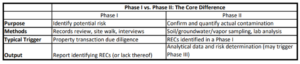
A Phase I Environmental Site Assessment is essentially a records and observation-based investigation. There’s no soil boring, no groundwater sampling, no lab work involved — it’s about identifying whether a property has a potential for contamination based on its history and current condition.
A Phase I typically includes:
- Historical records review — old maps, aerial photos, city directories, and prior land use records
- Regulatory database search — checking federal, state, and local environmental databases for known contamination, spills, or violations on or near the site
- Site survey — a physical walk-through looking for signs of contamination (stained soil, odors, storage tanks, drums, etc.)
- Interviews — conversations with property owners, occupants, and local government officials
- Report and findings — the assessment concludes with a determination of “Recognized Environmental Conditions” (RECs) — evidence suggesting a contamination risk exists
A Phase I is often required as part of due diligence in commercial real estate transactions, and it’s also the standard used to qualify for certain liability protections under federal environmental law (like CERCLA’s “innocent landowner” defense).
A Phase I does not confirm contamination. It identifies risk and tells you whether further investigation is warranted.
What Is a Phase II ESA?
If a Phase I turns up one or more Recognized Environmental Conditions, a Phase II is the logical next step.
A Phase II typically includes:
- Soil sampling — borings taken at strategic locations based on the Phase I findings
- Groundwater sampling — monitoring wells installed and sampled to check for contamination in groundwater
- Soil vapor or air sampling — when vapor intrusion is a concern
- Laboratory analysis — samples are tested for specific contaminants of concern (petroleum products, solvents, metals, PFAS, etc., depending on the site’s history)
- Data evaluation — results are compared against applicable state or federal cleanup standards to determine if contamination exceeds actionable levels
Unlike a Phase I, a Phase II gives you actual data — confirmed presence (or absence) of contamination, concentration levels, and often the beginning of a picture of how far contamination has spread.
What About a Phase III ESA?
You’ll sometimes hear the term “Phase III” in the industry, though it’s worth noting it isn’t a formally standardized designation the way Phase I and Phase II are under ASTM standards. Generally, when people refer to a Phase III, they mean the remediation or corrective action stage — actually addressing the contamination confirmed in a Phase II. This can include remediation system design and installation (pump-and-treat, soil vapor extraction, bioremediation, excavation, etc.), followed by ongoing monitoring to confirm the remedy is working and to support eventual regulatory closure. Because the term isn’t universally defined, some firms and states use different names for this stage (remedial action, corrective action plan implementation, etc.) — so it’s worth clarifying terminology with your consultant or regulator rather than assuming everyone means the same thing by “Phase III.”
Why It Matters
For property buyers, lenders, and developers, skipping straight to a purchase without a Phase I can mean taking on unknown environmental liability. And skipping a warranted Phase II after a Phase I flags concerns can mean building, lending, or operating on a site with contamination that surfaces — often expensively — down the road.
For firms conducting the work, understanding where a client sits in this process shapes everything from scope of work to equipment needs. A Phase II, in particular, is where reliable, contamination-free sampling equipment becomes critical — a single cross-contamination event during soil or groundwater sampling can compromise data that a client may be relying on for a major transaction decision.
Have questions about equipping your team for Phase II sampling work? Reach out to Aqua Bailers — we’ve supported environmental firms with reliable sampling equipment for over 30 years.